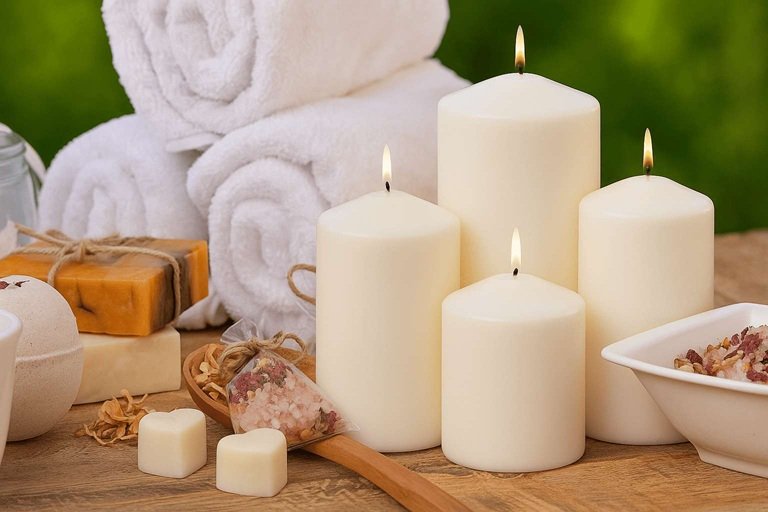
Designer candles are no longer simply sources of light. In contemporary interiors, they can become visual accents, fragrance rituals, mindfulness cues and small sensory anchors that change how a room feels.
From a sculptural candle placed on a coffee table to a softly scented soy wax candle beside a meditation cushion, the right candle can influence the visual character, fragrance profile and emotional atmosphere of a space. This is one reason the growing interest in designer candles for home décor overlaps naturally with aromatherapy, mindfulness, yoga, meditation and modern wellness.
In this guide, we explore the psychology of beautiful spaces and examine how candlelight, colour, form, fragrance and ritual can work together to create environments that feel calmer, warmer, more intentional and more personal. We also look at how handmade vegan soy candles with essential oils, natural aromatherapy candles and decorative pillar candles can become part of everyday wellness rituals.
The Psychology of Beautiful Spaces
A beautiful room is not defined only by expensive furniture, architectural details or designer accessories. Often, its character comes from the way different sensory elements work together. Light, colour, texture, sound, fragrance and spatial arrangement can collectively influence how a person experiences an environment.
This is where candles become surprisingly powerful decorative objects. A candle occupies very little physical space, yet it can introduce several sensory dimensions at once. A sculptural candle contributes shape. A coloured candle contributes visual identity. Candlelight contributes movement and warmth. Fragrance contributes another layer of sensory character. And the act of lighting a candle can create a psychological transition between one activity and another.
Imagine two otherwise identical rooms. One is brightly illuminated by overhead lighting, filled with visual clutter and has no particular scent. The second uses softer illumination, carefully selected textures, a few meaningful objects and a beautifully designed candle. Even without changing the furniture, the second environment may feel more intimate and intentional.
The candle is not magically transforming the architecture. Instead, it is participating in the sensory composition of the room.
This distinction matters. Candles should not be presented as medical treatments for anxiety, depression, insomnia or other health conditions. Their value in wellness-oriented environments is better understood as part of an intentional sensory experience: a cue to slow down, pause, breathe, reflect or transition into a quieter activity.
That makes candles for mindfulness practice particularly interesting. The candle becomes an object of attention. The flame provides a gentle visual point. The fragrance can become part of a sensory ritual. The act of lighting the candle can signal that it is time to move away from the pace of work and toward a more deliberate state of mind.
Beauty is experienced, not merely observed
Interior design is often discussed visually, but humans do not experience rooms through sight alone. We hear them, smell them, touch their surfaces and experience their temperature and lighting. A truly beautiful space therefore has a sensory dimension.
Designer candles fit naturally into this idea because they can combine visual and olfactory design in a single object.
A handmade candle can also communicate craftsmanship. Small variations, carefully selected forms and artisanal finishing can make the object feel less mass-produced and more connected to the idea of slow living.
For homeowners who want interiors that feel sophisticated without becoming overly formal, a carefully selected candle can function as a subtle finishing element.
Why Candles Matter in Interior Atmosphere
Atmosphere is difficult to measure because it is experiential. It is the feeling that emerges when visual design, lighting, sound, scent and activity interact.
A candle can influence atmosphere in several ways:
- Light: the flame creates a warm, moving source of illumination.
- Fragrance: scented candles introduce an additional sensory layer.
- Form: sculptural and designer candles become decorative objects.
- Colour: candle colours can complement or contrast with interior palettes.
- Ritual: lighting a candle can create a transition between activities.
- Association: familiar fragrances may become connected with particular places, people or routines.
This combination explains why candles appear across so many lifestyle settings. They can be used in bedrooms, living rooms, dining spaces, bathrooms, meditation corners, yoga studios, spas and hospitality environments.
The same candle can also communicate different meanings depending on where it is placed. On a dining table, it can suggest intimacy. Beside a bath, it can suggest relaxation. In a meditation corner, it can function as a mindfulness cue. On a bookshelf, it can operate primarily as décor.
From decoration to sensory architecture
Traditional décor tends to focus on objects that occupy visual space. Sensory décor expands the concept by considering how an object affects the experience of the entire room.
A candle can therefore be thought of as a small piece of sensory architecture.
It creates a point of visual focus while simultaneously interacting with the surrounding atmosphere. When paired with natural materials such as wood, stone, linen, ceramic and glass, handmade candles can reinforce an interior's tactile and organic character.
This is particularly relevant to contemporary wellness-inspired interiors, where people increasingly want homes to feel restorative rather than merely impressive.
The Five-Sensory Experience of Designer Candles
The appeal of designer candles becomes clearer when we consider them through the five senses.
1. Sight: the psychology of candlelight
Light is one of the most influential elements in interior atmosphere. Hard, uniform lighting can make a room feel functional and energetic, while softer pools of light can create a more intimate visual environment.
The movement of a flame adds another dimension. Unlike a static lamp, a flame continuously changes. It flickers, expands and contracts, creating subtle visual movement.
That movement can make a candle feel alive.
This is one reason candlelight has such a strong association with dinners, ceremonies, celebrations and quiet evenings. The flame does more than illuminate an object; it becomes part of the experience.
2. Smell: fragrance as an environmental layer
Fragrance can influence how a room is perceived because smell is closely connected with memory and personal association.
A lavender-inspired fragrance may remind someone of a peaceful evening. A woody fragrance may evoke forests or quiet interiors. A citrus profile may feel bright and fresh. Floral notes can create a softer decorative impression.
These responses are highly individual. There is no single fragrance that will create exactly the same psychological response for everyone.
For this reason, selecting meditation candles with essential oils or aromatherapy-inspired candles should involve personal preference rather than promises of guaranteed emotional outcomes.
3. Touch: material and craftsmanship
The physical surface of a candle contributes to its decorative identity. Smooth wax, sculptural forms, embossed details and handmade finishes can make a candle interesting even before it is lit.
This is especially relevant for handmade soy wax pillar candles, where shape itself becomes part of the décor.
4. Sound: the quietness around the flame
A candle does not produce much sound, and that can actually be part of its appeal. In a quiet room, a candle becomes one element within a low-stimulation environment.
When combined with soft music, natural ambient sounds or silence, candlelight can support the creation of a slower atmosphere.
5. Ritual: the sense of participation
The fifth dimension is not technically a sense, but it is essential: participation.
Lighting a candle is an action. Blowing it out is another action. Choosing a fragrance is a decision. Positioning the candle is a design choice.
These small actions can turn an ordinary evening into a more deliberate experience.
How Candlelight Changes the Perceived Atmosphere of a Room
One of the simplest ways to understand the psychology of candles is to compare candlelight with conventional overhead illumination.
Overhead lighting typically serves a practical purpose: it helps people see clearly. Candlelight performs a different role. Its intensity is lower, its movement is continuous and its illumination is localized.
As a result, candlelight can visually divide a room into zones.
A reading corner can feel distinct from the rest of a living room. A dining table can become the visual centre of an evening meal. A meditation cushion can appear more intentional when accompanied by a small candle.
Warmth without visual overload
Minimalist interiors can sometimes feel visually cold when they rely heavily on hard surfaces, neutral colours and strong architectural lines. A candle introduces a small amount of movement and warmth without requiring a major redesign.
This makes calming aromatherapy candles for home useful as decorative accents in interiors where the goal is understated comfort.
The power of visual focus
Humans naturally orient attention toward salient objects. A small flame can provide a simple visual anchor in an otherwise quiet setting.
For mindfulness, this can be useful as long as the person finds the practice comfortable and safe. The candle can be one focal point among many possible mindfulness objects.
The goal is not to force concentration on the flame. Instead, it can provide a gentle cue to become aware of the present environment.
The Relationship Between Fragrance, Memory and Emotion
Fragrance is one of the most personal elements of a candle.
Unlike visual décor, which can be appreciated from across a room, fragrance is experienced through the air. It can therefore become an invisible layer of interior design.
Fragrance also has a powerful relationship with memory. A particular scent may remind someone of a garden, a holiday, a childhood home, a forest, a spa or a familiar personal ritual.
This makes scent selection highly subjective.
Lavender and evening rituals
Lavender is widely associated with relaxation and bedtime rituals, which helps explain the popularity of natural lavender soy candles for sleep.
However, a candle should not be presented as a treatment for sleep disorders. A better approach is to use a lavender-scented candle as one element of an evening wind-down routine while following safe candle practices and avoiding leaving a burning candle unattended.
Woody fragrances and grounded interiors
Woody fragrance families can complement interiors containing timber, leather, stone, linen and earthy colours.
A cedar, sandalwood or forest-inspired fragrance can create a visual and olfactory connection between an interior and the natural world.
Floral fragrances and softness
Floral notes can work particularly well in bedrooms, dressing areas and softly decorated living spaces.
Citrus and bright environments
Citrus-oriented fragrances can complement bright, airy interiors and daytime rituals.
The key principle is simple: choose fragrance based on the atmosphere you personally enjoy rather than expecting a particular scent to produce a guaranteed psychological outcome.
Why Designer Candle Design Matters
A designer candle does not need to be extravagant to make a visual impact. Often, the strongest designs are based on proportion, texture and simplicity.
A sculptural candle can work almost like a small piece of contemporary art. A refined jar candle can create an impression of understated luxury. A tall pillar candle can introduce verticality to a tabletop.
Shape as décor
Shape influences how a candle interacts with surrounding objects.
A rounded candle can soften an angular room. A tall pillar can complement vertical architectural lines. A geometric candle can reinforce contemporary décor.
This is why vegan decorative pillar candles can be used even when the owner has no intention of lighting them immediately.
Colour as emotional styling
Colour influences visual atmosphere and should be selected according to the overall palette of the room.
Neutral candles can disappear elegantly into minimalist interiors. Deep tones can create contrast. Soft colours can reinforce a serene aesthetic.
Composition matters more than quantity
One beautifully positioned candle can often have more impact than a crowded collection.
Try grouping a candle with two or three complementary objects: a ceramic bowl, a small plant, a book, a stone tray or a sculptural accessory.
This creates a visual story rather than simply placing another object on a surface.
Why Soy Wax Candles Suit Wellness-Inspired Spaces
For consumers interested in natural living, wax choice is an important part of candle selection.
Soy wax is a plant-derived wax commonly used in modern candle making. It is popular among consumers seeking alternatives to conventional paraffin-based candles and is particularly associated with handmade and eco-conscious candle brands.
For a wellness-oriented interior, the appeal of mistico opus soy wax candles is therefore not only visual. Soy wax candles can fit naturally into a broader lifestyle preference for considered materials, handmade products and intentional rituals.
What makes a candle feel wellness-oriented?
- A thoughtfully selected fragrance.
- A visually calming design.
- A considered wax choice.
- Appropriate use of fragrance ingredients.
- Responsible burning practices.
- Packaging and presentation that support the overall experience.
- A clear connection to relaxation, mindfulness or personal ritual without making exaggerated health claims.
These characteristics help explain why searches for eco friendly soy candles for meditation, natural wellness candles for meditation and vegan soy wax aromatherapy candles increasingly overlap with searches for home décor and lifestyle products.
Candles for Mindfulness Practice: Creating a Sensory Anchor
Mindfulness is fundamentally about paying attention to the present moment with greater awareness. A candle can become a simple sensory anchor within that practice.
Consider a five-minute ritual:
- Choose a quiet and safe location.
- Place the candle on a stable, heat-resistant surface.
- Reduce unnecessary visual distractions.
- Light the candle safely.
- Take a few slow, comfortable breaths.
- Notice the flame without forcing your attention.
- Observe the fragrance, temperature and surrounding sounds.
- When your mind wanders, gently return your attention to the present experience.
- Extinguish the candle safely when finished.
This is why candles for mindfulness practice do not need to be elaborate. The most important element is the ritual of deliberate attention.
Why ritual can be powerful
Daily routines often become automatic. Ritual introduces intention.
When the same candle is used before meditation, journaling or quiet reading, lighting it can become a personal cue that signals a change of activity.
Over time, the candle may become associated with a specific part of the day.
Candles for a Peaceful Meditation Space
A meditation room does not need expensive furniture. It needs a comfortable place to sit and an environment that supports minimal distraction.
Candles can complement that environment through subtle light and fragrance.
Where should a meditation candle be placed?
Place the candle on a stable, heat-resistant surface where it cannot be knocked over and where the flame remains safely away from fabrics, paper, curtains and other combustible materials.
For visual meditation, the candle can be positioned at a comfortable viewing distance. There is no need to stare continuously at a flame. The purpose is simply to create an intentional visual anchor.
Choosing fragrance for meditation
For candles for peaceful meditation space, select fragrances that you personally find pleasant and non-distracting.
Some people prefer lavender. Others prefer sandalwood-inspired, cedar, floral or unscented candles. The best meditation fragrance is ultimately the one that does not compete for attention.
Natural soy pillar candles for meditation can be especially attractive where the candle itself is intended to remain visible as part of the room design.
Candles for Spiritual Meditation and Rituals
Candles have been used in spiritual and ceremonial settings across many cultures. Their symbolic meanings vary significantly by tradition.
For some people, a flame represents presence, devotion, remembrance, illumination or transition. For others, it is simply a beautiful object that creates a contemplative environment.
Modern consumers can incorporate candles into personal rituals without assuming that the candle itself has supernatural or guaranteed healing properties.
Essential oil candles for spiritual rituals can therefore be selected according to the individual's personal associations with particular fragrances.
A simple personal ritual
Light the candle, sit quietly for a few moments, establish an intention for the session and allow yourself to become aware of the flame, fragrance and surrounding environment.
The value is in the meaning you give the ritual.
This makes candles for spiritual meditation particularly relevant to people who want to create a dedicated corner for reflection, prayer, contemplation or journaling.
Candles for Yoga Practice
Yoga spaces often benefit from a calm sensory environment. Natural materials, uncluttered layouts and gentle lighting can support the overall ambience of a practice area.
Natural candles for yoga studio environments can complement wooden floors, woven mats, plants and neutral textiles.
At home, a candle can be placed outside the movement area rather than directly beside a mat.
Natural essential oil candles for yoga may appeal to people who enjoy fragrance as part of their practice, but fragrance should always be selected according to personal tolerance and preference.
Yoga and sensory transitions
A candle can be lit before beginning a session and extinguished after the final relaxation period. The repeated sequence creates a ritual boundary around the practice.
Over time, this can make the yoga space feel more intentional without requiring a permanent room renovation.
Candles and Evening Wind-Down Rituals
The transition from a busy day to a quieter evening can be difficult when screens, notifications and work-related tasks continue until bedtime.
A candle can become part of a deliberate wind-down ritual.
For example, an evening routine might include dimming the main lights, putting away work devices, taking a shower, reading a book and enjoying a favourite fragrance for a short period before the candle is safely extinguished.
This explains the popularity of searches such as lavender candles for better sleep and candles that help improve sleep naturally.
However, it is important to distinguish between a calming ritual and a medical treatment. A candle cannot be relied upon to treat insomnia or another sleep disorder. If persistent sleep problems are affecting daily life, appropriate professional guidance is more important than any home fragrance product.
Using candles safely at night
Never fall asleep while a candle is burning. Extinguish it before leaving the room or going to bed.
Battery-operated flameless candles can be a useful alternative when a person wants ambient light without an open flame.
Aromatherapy Candles and Relaxation
Aromatherapy-inspired candles are often marketed around relaxation, emotional balance and stress relief. The most responsible way to approach these products is to consider them environmental and sensory tools rather than medical interventions.
Organic aromatherapy candles for stress relief can become part of a broader relaxation environment that includes comfortable seating, lower lighting, music, breathing exercises and reduced digital stimulation.
The candle itself may help establish the ritual.
Why rituals can feel calming
Rituals provide predictability. When a person repeatedly performs a calming sequence, the sequence can become psychologically associated with downtime.
Lighting a favourite candle before journaling is a simple example.
Using essential oil candles for emotional balance can similarly become a personal sensory practice, provided that fragrance preferences, sensitivities and safe-use instructions are respected.
A complete relaxation environment
Instead of relying on one product, create a multi-sensory environment:
- Soft, warm lighting.
- A comfortable chair or floor cushion.
- A fragrance you genuinely enjoy.
- Natural textures such as cotton, linen, wood or ceramic.
- Low background noise.
- A short period without notifications.
- A simple activity such as reading, stretching, breathing or journaling.
Creating a Calming Home Environment with Candles
A calming home is not necessarily a minimalist home. It is a home in which the sensory environment feels intentional to the people who live there.
Candles for calming home environment can be used strategically rather than everywhere.
Use one visual anchor
Select a candle that complements the room's colour and material palette.
Think in layers
Combine candlelight with table lamps, wall lights and natural daylight rather than making the candle responsible for all illumination.
Choose fragrance according to room function
A bedroom may suit softer fragrances. A living room can accommodate more distinctive profiles. A workspace may benefit from a subtle or unscented option to reduce sensory distraction.
Avoid fragrance overload
Several strong fragrances competing in the same room can become unpleasant. One well-selected candle is often sufficient.
How to Use Designer Candles in Different Rooms
Living room
The living room is ideal for designer candles because it combines social activity with relaxation. A sculptural pillar candle can become a coffee-table accent, while a jar candle can sit on a console, sideboard or shelf.
Bedroom
Bedrooms often benefit from subtle fragrance and low lighting. A candle can become part of an evening ritual, but it should always be extinguished before sleeping.
Bathroom
A candle beside a bath can transform an ordinary bathroom into a more spa-inspired environment. Keep the candle well away from water and flammable materials.
Dining area
Designer candles can create a more intimate dining atmosphere. Choose proportions that do not obstruct conversation or sightlines.
Entryway
A decorative candle can make an entryway feel finished and welcoming. If the candle is primarily decorative, it does not necessarily need to be lit.
Meditation corner
A meditation corner is one of the most natural environments for soy wax jar candles for meditation and soy wax meditation pillar candles. Keep the arrangement minimal and distraction-free.
Home office
Use fragrance carefully in a workspace. Some people prefer unscented candles because strong fragrance can be distracting during prolonged concentration.
Pillar Candles vs Jar Candles: Which Is Better for Your Space?
Both pillar and jar candles have distinct aesthetic strengths.
Jar candles
Handmade aromatherapy jar candles are convenient for consumers who want fragrance combined with a contained candle format. They can work beautifully on bedside tables, desks, consoles and shelves.
Searches for handmade organic jar candles India, organic essential oil jar candles and organic wellness jar candles reflect interest in combining decorative design with fragrance and wellness rituals.
Pillar candles
Pillar candles are often more sculptural. They can be displayed individually or grouped in varying heights.
Handmade wellness pillar candles can work particularly well in contemporary interiors because their physical form remains visible.
Which should you choose?
Choose a jar candle if fragrance and convenience are your priorities. Choose a pillar candle if sculptural appearance and visual styling are more important. Many homes can benefit from both.
The Rise of Luxury Soy Wax Candles
Luxury is changing.
In traditional décor, luxury was often communicated through expensive materials, large objects and visible branding. Modern luxury increasingly emphasises craftsmanship, sensory quality, authenticity and restraint.
This shift has created space for luxury soy candles that function as both lifestyle products and decorative objects.
A well-made candle can communicate luxury through:
- Handcrafted production.
- Thoughtful fragrance development.
- High-quality presentation.
- Sculptural forms.
- Natural or plant-derived wax choices.
- Attention to detail.
- A strong connection between product and ritual.
The result is a product that does not simply sit on a shelf waiting to be consumed. It participates in the visual identity of the room.
Luxury without excess
The strongest luxury interiors often contain fewer objects, not more. Each object needs a reason to be there.
A designer candle can fit this philosophy because it can simultaneously provide decoration, fragrance and ritual.
Mistico Opus: Handmade Soy Wax Candles for Sensory Living
For consumers looking to bring this philosophy into their own homes, Mistico Opus offers a natural connection between handmade candle design, soy wax, aromatherapy and wellness-inspired living.
The brand can be positioned within the broader movement toward handmade vegan soy candles with essential oils, natural aromatherapy products and thoughtfully designed candles for contemporary Indian homes.
For shoppers searching for Mistico Opus aromatherapy candles, Mistico Opus essential oil candles, Mistico Opus handmade vegan candles, Mistico Opus luxury soy candles, Mistico Opus meditation candles and Mistico Opus natural aromatherapy candles, the appeal is the opportunity to combine aesthetic design with a personal sensory ritual.
Mistico Opus also fits naturally into searches around Mistico Opus eco friendly candles, Mistico Opus organic scented candles, Mistico Opus soy wax candles and Mistico Opus wellness candles.
Rather than thinking of an aromatherapy candle as merely a fragrance product, consumers can approach it as part of a complete lifestyle environment: a beautiful object, a source of ambient light and a cue for slowing down.
Explore Mistico Opus candles and discover handmade candle options designed for modern sensory living.
Why handmade matters
Handmade production has an emotional appeal that extends beyond the physical object. Consumers often associate handmade goods with craftsmanship, care and individuality.
That perception is particularly relevant to candles because candle making combines material science with visual design and fragrance artistry.
Every stage matters: wax selection, melting, fragrance integration, wick choice, mould or vessel selection, curing, finishing and presentation.
How to Choose the Right Designer Candle for Your Home
Buying a candle should begin with the atmosphere you want to create rather than simply the fragrance name.
Step 1: Decide what the candle is for
Is it primarily décor, relaxation, meditation, yoga, evening ambience, gifting or fragrance?
Step 2: Choose the format
Choose jar candles for a contained decorative format and convenient fragrance experience. Choose pillars when the candle's shape is an important part of the interior styling.
Step 3: Select the fragrance
Consider fragrances you already know you enjoy. If you dislike a fragrance in perfume, you will probably not enjoy having it throughout your living room.
Step 4: Consider the room
A large room may accommodate a more noticeable fragrance. A small bedroom may benefit from something softer.
Step 5: Consider the visual palette
Match or intentionally contrast the candle with furniture, walls and accessories.
Step 6: Look at materials and ingredients
Consumers interested in natural living may prefer plant-derived waxes, vegan formulations and thoughtfully selected fragrance ingredients.
Step 7: Check candle care information
A high-quality candle should be used according to its care instructions. Wick trimming, appropriate burn time and safe placement all contribute to responsible candle use.
How to Build a Personal Candle Ritual
The most meaningful candle experience is often personal.
You do not need an elaborate wellness routine. A five-minute ritual can be enough.
Morning ritual
Light a subtle candle while journaling or planning the day. Keep the fragrance light if you are also working or exercising.
Post-work ritual
After finishing work, change the lighting, put away your devices and light a favourite candle. This creates a psychological boundary between professional and personal time.
Meditation ritual
Light a candle, sit comfortably and spend several minutes observing your breathing and surroundings.
Yoga ritual
Light a candle before beginning your practice and extinguish it after the final relaxation.
Reading ritual
Pair a candle with a book, warm drink and comfortable chair. The candle becomes part of the environmental composition rather than the centre of attention.
Weekend ritual
Use a more decorative candle when entertaining guests. A sculptural candle can become a conversation piece even when unlit.
How to Pair Candle Fragrance with Interior Style
Interior fragrance can be treated like another design material.
Minimalist interiors
Choose subtle, clean or understated fragrances and simple candle forms.
Bohemian interiors
Earthy, woody or botanical fragrance profiles can complement natural textiles, plants and handmade accessories.
Contemporary interiors
Geometric or sculptural candles can reinforce architectural lines. More sophisticated fragrance combinations can complement the modern aesthetic.
Traditional interiors
Warm floral, woody or spice-inspired fragrances can work with classic furniture and rich textures.
Japandi-inspired spaces
Natural materials, restrained colour palettes and minimal candle arrangements work particularly well together.
Spa-inspired bathrooms
Soft floral, botanical or woody profiles can complement stone, glass, towels and natural textures.
Sensory Design: Why the Best Rooms Engage More Than the Eyes
One of the biggest advantages of candles is that they bridge visual design and sensory experience.
A beautiful vase may contribute shape and colour. A fragrance diffuser may contribute scent. A lamp may contribute light. A candle can combine several of these functions in one object.
This makes candles particularly effective for people who want their homes to feel emotionally expressive rather than purely functional.
Consider a coffee table with a ceramic vase, a book, a small bowl and a handmade pillar candle. Each object has a different texture. The candle adds visual rhythm and, when lit, introduces movement.
The room has become more than a collection of objects. It has become an experience.
Why Designer Soy Wax Candles Are Relevant to Indian Homes
Indian homes can vary enormously in architectural style, climate, family structure and interior aesthetics. Yet candles can adapt to almost any environment because they require very little space.
The growing interest in wellness, mindfulness, yoga and home décor also creates a natural place for aromatherapy-inspired candle products.
Searches for vegan scented jar candles India, handmade organic jar candles India and luxury soy wax aromatherapy candles India reflect a wider consumer interest in products that combine lifestyle, aesthetics and conscious purchasing.
Urban apartments
In compact apartments, one carefully chosen candle can make a significant visual difference without consuming valuable space.
Large family homes
Different rooms can use different candle styles according to their functions.
Yoga and meditation corners
A candle can visually define a dedicated wellness corner without requiring permanent construction.
Festive entertaining
Candles can also contribute to dining tables and festive décor when used safely and thoughtfully.
Designer Candles as Part of a Modern Wellness Lifestyle
Wellness is increasingly understood as more than exercise and nutrition. It also includes the environments in which people spend their time.
A home can support moments of restoration through lighting, sound, organisation, nature, movement and sensory comfort.
Natural wellness candles for meditation and organic aromatherapy pillar candles can become small components of that environment.
The important principle is moderation. A wellness product does not need to promise dramatic transformation. Sometimes its role is simply to help make a desirable routine easier to repeat.
A candle can serve exactly that purpose.
Understanding “Toxin-Free” and Natural Candle Marketing
Consumers increasingly search for phrases such as toxin free aromatherapy candles for home and toxin free scented candles with essential oils.
When evaluating such claims, consumers should look beyond marketing terminology and examine the actual product information provided by the manufacturer.
Ask what wax is used, what fragrance ingredients are used, whether the product is vegan, what wick materials are used and what safety information is provided.
Natural does not automatically mean risk-free, and essential oils can cause sensitivities for some individuals. Good product descriptions should therefore be transparent and specific.
Aromatherapy Candles and Chakra-Inspired Spaces
Some consumers incorporate fragrance and colour into chakra-inspired meditation spaces.
Aromatherapy candles for chakra healing are best approached as symbolic and sensory tools rather than medical treatments.
For example, a person might choose colours and fragrances that have personal significance within their meditation practice.
The important part is the meaning attached to the ritual.
A candle can become a visual reminder of an intention, such as grounding, reflection, gratitude, compassion or focus.
Using Candles to Create an Emotional Atmosphere at Home
Every home has an emotional atmosphere.
Some spaces feel energetic and social. Others feel quiet and private. The same room can feel different at different times of day.
Candles can help people intentionally shift between these modes.
For example, a bright room with energetic lighting may be appropriate for daytime work. Later, the overhead lights can be reduced and a candle can be introduced for reading or conversation.
This simple transition can make the home feel more dynamic.
In this sense, candles are not merely decorative products. They can become environmental cues.
Why Handmade Candles Make Meaningful Gifts
A candle is a highly adaptable gift because it can communicate different messages depending on its design.
- A sculptural pillar candle can represent appreciation for someone's sense of style.
- An aromatherapy jar candle can suit someone who enjoys relaxing rituals.
- A luxury soy wax candle can work as an elegant housewarming gift.
- A meditation candle can suit someone interested in mindfulness.
- A vegan candle can appeal to consumers who intentionally avoid animal-derived ingredients.
Handmade candles also carry an artisanal character that can make gifting feel more personal.
Designer Candles and the Philosophy of Slow Living
Slow living is not about doing everything slowly. It is about becoming more intentional about what deserves attention.
Lighting a candle can be a small expression of this philosophy.
Instead of eating dinner while scrolling through a phone, someone might turn off unnecessary notifications, light a candle and focus on the meal.
Instead of ending the workday with another hour of emails, someone might create a short transition ritual involving tea, music and candlelight.
The candle itself is not the solution. The intentional behaviour surrounding it is what gives it meaning.
Seven Design Principles for Using Candles Beautifully
1. Create contrast
Place a light candle against a darker surface or a dark candle against a light background.
2. Use odd-numbered groupings
Three candles of different heights can create a visually balanced arrangement.
3. Mix textures
Combine wax with wood, ceramic, glass, stone or linen.
4. Leave breathing space
Do not overcrowd the surface around the candle.
5. Consider height
Varying candle heights can create visual rhythm.
6. Match the room's palette
Choose colours that complement existing décor.
7. Let the candle remain a candle
Do not over-style it. Sometimes the simplest presentation is the most sophisticated.
Candle Safety: Enjoy the Atmosphere Responsibly
Beautiful candle design should always be accompanied by responsible use.
- Never leave a burning candle unattended.
- Keep candles away from curtains, paper, bedding and other flammable materials.
- Keep candles away from children and pets.
- Place candles on stable, heat-resistant surfaces.
- Keep multiple candles appropriately separated.
- Follow the manufacturer's recommended burn instructions.
- Do not move a candle while the wax is liquid or the container is hot.
- Extinguish candles before leaving the room or going to sleep.
- Stop using a candle when it reaches the manufacturer's recommended end-of-life point.
If fragrance sensitivity is a concern, choose an appropriate product, ventilate the space and discontinue use if the fragrance causes discomfort.
The Future of Designer Candles: From Home Fragrance to Sensory Design
The future of candles is likely to be increasingly connected to design, personalisation and wellness-oriented lifestyles.
Consumers no longer necessarily want products that perform one function. They want objects that contribute to an overall lifestyle.
A candle can therefore be simultaneously:
- A home décor object.
- A fragrance product.
- A mindfulness cue.
- A gift.
- A decorative accent.
- A personal ritual object.
- A symbol of slow living.
This convergence makes designer candles particularly interesting.
The category is moving beyond the question, “What does this candle smell like?” toward broader questions such as, “How does this candle make my space feel?” and “What kind of experience do I want to create?”
Conclusion: Beautiful Spaces Begin with How They Feel
The psychology of beautiful spaces is ultimately about experience.
A room can be visually impressive and still feel uncomfortable. Conversely, a relatively simple room can feel deeply welcoming because its lighting, materials, fragrance, sound and objects work together.
Designer candles occupy an interesting position within this sensory landscape. They combine visual form, candlelight, fragrance and ritual in a single object.
Whether you are searching for candles for meditation and relaxation, natural candles for yoga studio spaces, organic scented pillar candles, soy wax jar candles for relaxation, relaxing scented candles for stress or simply a beautiful decorative candle for your living room, the most important consideration is the experience you want to create.
Handmade soy wax candles can be particularly appealing to people who value craftsmanship, natural-inspired materials, vegan choices and thoughtful design. When paired with appropriate fragrance and used safely, they can become meaningful components of modern interiors.
That is the deeper appeal of brands such as Mistico Opus: the candle can be considered not merely as something that burns, but as part of a broader philosophy of sensory living.
A flame can mark the beginning of meditation. A fragrance can become associated with an evening ritual. A sculptural form can finish a coffee table. A softly illuminated corner can invite conversation. And a few quiet minutes beside a candle can become a reminder to pause.
Beautiful spaces are not only spaces that look good. They are spaces that feel good to inhabit.
And sometimes, creating that feeling begins with something as simple as lighting a candle.
Frequently Asked Questions About Designer Candles, Mood, Meditation and Aromatherapy
1. How do designer candles influence mood?
Designer candles can influence the perceived atmosphere of a room through candlelight, fragrance, colour, shape and ritual. A warm flame can create visual intimacy, while a preferred fragrance can contribute to a personally calming environment. Individual responses vary, so candles are best viewed as sensory and environmental tools rather than guaranteed mood treatments.
2. Are candles good for mindfulness practice?
Yes. Candles can be used as a simple sensory anchor during mindfulness practice. The flame provides a visual point of attention, while the fragrance and act of lighting the candle can become part of a deliberate ritual. Always use an open flame safely and extinguish it before leaving the room.
3. What are the best candles for a peaceful meditation space?
The best meditation candle is one with a fragrance and design that you personally find calming and non-distracting. Soy wax jar candles, natural soy pillar candles and subtle aromatherapy candles can all work well. Place the candle securely on a heat-resistant surface away from fabrics and other flammable objects.
4. Are soy wax candles suitable for meditation?
Soy wax candles can be suitable for meditation because they can combine gentle ambient light with fragrance and attractive decorative forms. Consumers interested in natural products often choose soy wax because it is plant-derived. The fragrance and overall candle formulation should also be considered when selecting a product.
5. What are aromatherapy candles used for?
Aromatherapy candles are commonly used to create a pleasant sensory environment through fragrance and candlelight. They can be incorporated into relaxation, meditation, yoga, bathing and evening routines. They should not be considered substitutes for professional medical treatment.
6. Can lavender candles help with sleep?
Lavender fragrance is commonly associated with relaxation and bedtime routines, which is why lavender candles are popular for evening use. However, a candle should not be considered a treatment for insomnia or other sleep disorders. Never leave a candle burning while sleeping.
7. What are the benefits of handmade vegan soy candles?
Handmade vegan soy candles appeal to consumers who value plant-derived wax, vegan product choices and artisanal craftsmanship. They can also function as decorative objects when their shapes, colours and containers are thoughtfully designed.
8. How can candles create a calming home environment?
Candles can contribute to a calming home environment through softer lighting, pleasant fragrance and intentional rituals. For best results, combine candlelight with comfortable textures, reduced visual clutter, quiet music or silence and activities such as reading, meditation or journaling.
9. Are designer candles suitable for home décor?
Yes. Designer candles can function as decorative objects even when they are not lit. Sculptural pillar candles can add shape and texture, while elegant jar candles can complement shelves, consoles, coffee tables, bedrooms and dining areas.
10. What is the difference between soy wax pillar candles and soy wax jar candles?
Soy wax pillar candles are freestanding candles that often emphasise sculptural shape and visual design. Soy wax jar candles are contained within a vessel and are commonly selected for fragrance, convenience and decorative presentation. Both formats can be used for relaxation and home ambience.
11. Are essential oil candles good for yoga practice?
Essential oil candles can be incorporated into a yoga environment when the fragrance is personally comfortable and does not distract from practice. Keep candles away from the movement area and other flammable materials, and extinguish them after the session.
12. What candles are best for spiritual meditation?
The best candle for spiritual meditation is one that supports the individual's preferred ritual and does not become a distraction. Some people prefer essential oil candles, while others prefer unscented or lightly scented soy candles. Candle symbolism and fragrance preferences are personal and can vary by spiritual tradition.
13. How do I choose a candle for relaxation?
Choose a candle with a fragrance you genuinely enjoy, a design that complements your space and a format appropriate for the room. Lavender, floral, botanical and woody profiles are common choices for relaxation-oriented environments, but fragrance preferences are highly individual.
14. Are Mistico Opus candles suitable for meditation and wellness spaces?
Mistico Opus offers handmade candle products that can fit naturally into meditation, relaxation, home décor and wellness-inspired environments. Consumers can explore the brand's current collection and individual product information at Mistico Opus.
15. What makes a candle feel luxurious?
A luxury candle is usually defined by a combination of craftsmanship, fragrance quality, visual design, materials, presentation and overall sensory experience. A beautifully designed soy wax candle can feel luxurious without being visually excessive when it complements the surrounding interior with restraint and intention.
Bring More Intention into Your Space with Mistico Opus
If your idea of home décor extends beyond what looks beautiful to include what feels beautiful, handmade aromatherapy candles can become a meaningful part of your environment.
Explore Mistico Opus for handmade soy wax candles and discover pieces that can complement meditation corners, yoga spaces, bedrooms, living rooms and contemporary wellness-inspired interiors.